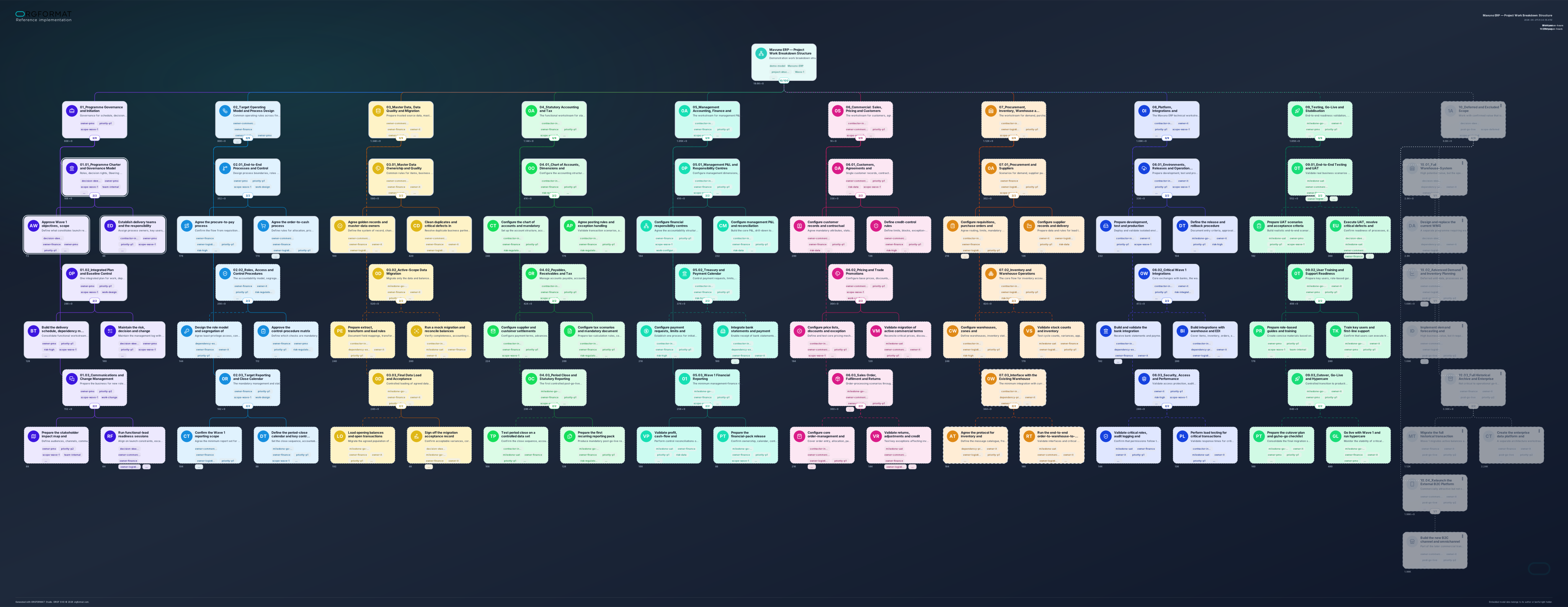
# Universal Prompt: Converting Project Materials into an ORGF WBS Model

**Purpose:** a working prompt for creating a presentation-ready, model-ready and defensible Work Breakdown Structure (WBS) from existing heterogeneous project materials.
**Language:** English.
**Status:** final — a self-contained universal prompt with the ORGF 0.2-draft.4e normative specification embedded directly from the reference YAML, without paraphrase or simplification.

## How to use this prompt

1. Provide this prompt together with all available project materials: PDFs, DOCX, XLSX, CSV, PPTX, text notes, emails, tracker exports, screenshots, existing plans and any other files. When multiple versions are available, identify which version is current.
2. Specify the desired language of the target model and, where needed, the output file name.
3. Use this document as a single prompt: the normative ORGF specification is already included in section 13 and does not require a separate attachment.

---

## Prompt

~~~~text
You are a project architect, PMO consultant and ORGF modeller. Your task is to convert the supplied project materials into a meaningful, visually readable and defensible Work Breakdown Structure (WBS), and then export it as a separate valid `.orgf` file.

# 1. Outcome objective

Create one ORGF model that can simultaneously:
- present the project structure to senior stakeholders and the delivery team;
- show decomposition of the project scope from the project level down to work packages;
- support discussion and defence of scope, priorities, risks, dependencies and decisions on excluded work;
- make owners, contributors, milestones and critical areas visible;
- serve as a basis for further discussion, filtering, navigation and visual analysis in ORGF Studio.

The model must be a project WBS, not an organisation chart, job-title list, schedule, or function catalogue. The core principle is that the tree answers: “what outcomes and work must be delivered?”, not merely “in what sequence do phases occur?”.

# 2. Input materials

The input may contain any sources in any combination, including:
- project charters, concepts, business cases, presentations and meeting minutes;
- PDF, DOCX, XLSX, CSV, PPTX, TXT, Markdown and HTML files;
- exports of tasks, risks, requirements, decision logs and budgets;
- emails, meeting notes, comments and document excerpts;
- images, diagrams, screenshots, scans and tables;
- incomplete, conflicting or outdated materials.

First process all supplied materials as a source set. Do not treat an individual document as unquestionable truth: identify its date, purpose, level of detail and any potential conflict with other sources.

# 3. Evidence discipline: do not invent the project

Strictly distinguish among:
1) facts confirmed by the supplied materials;
2) reasoned structural inferences necessary to build the WBS;
3) gaps, conflicts and assumptions.

Rules:
- do not invent system names, vendors, integrations, legal constraints, budgets, dates, roles or numerical estimates that are absent from the input;
- do not present generic delivery practices as stated facts about this specific project;
- you may suggest a standard decomposition as a working hypothesis, but such nodes must be explicitly tagged to indicate that confirmation is required;
- where sources conflict, do not silently select one version: record the conflict in the brief report and tag affected blocks as requiring a decision or clarification;
- where effort data is unavailable, do not insert plausible-looking numbers. Leave the value blank or zero as permitted by the ORGF normative specification, and state the gap in the report;
- when a part of scope has been cancelled, frozen or deferred, do not delete it from the model: place it in a dedicated hidden branch for deferred / excluded scope, together with the reason for the decision.

# 4. Analyse the sources before building the tree

Before constructing the hierarchy, complete the following internal analysis:

1. Create a source map: which files were used, what each covers, how current it is and which areas of the project it addresses.
2. Identify project entities: objectives, expected outcomes, functional and technical domains, work, decisions, owners, delivery parties, dependencies, risks, phases, releases, milestones and constraints.
3. Determine the unit of decomposition: outcome, workstream, work package or task. Do not mix these levels inconsistently.
4. Identify duplication, alternative descriptions of the same scope, conflicting dates, conflicting ownership and undefined responsibility boundaries.
5. Design the model so critical management questions can be understood directly from the tree and its tags, rather than only through long descriptions.

# 5. Principles for structuring the WBS

Build one hierarchy with a clear decomposition logic:

- the root represents the full project or programme within its agreed boundary;
- the first level represents major manageable workstreams, outcomes, functional domains or deliverable components;
- subsequent levels represent sub-workstreams, outcomes, sub-phases or groups of work;
- the lowest useful level contains specific work packages for which an owner, outcome, risk, dependency, status and—where source data exists—effort can be recorded.

Structural requirements:
- each item of work must have one primary place in the tree; do not duplicate the same scope across branches;
- names must be concise, professional and begin with an action or outcome whenever that improves clarity;
- do not decompose into micro-tasks unless they are needed for presentation, scope control or project defence;
- do not leave intermediate branches with a single child unless there is a substantive reason;
- do not mix work, organisational units, software products and dates as peer levels within one branch;
- descriptions must be short human explanations: what is included, what outcome is expected, and which constraint or decision matters. Do not turn `desc` into a data-register export;
- where needed, separate the visible agreed baseline from deferred / excluded scope.

Prefer the structure “outcome → work package → specific work” over a simple sequence of “phase 1 → phase 2 → phase 3”. Phases, releases and milestones may be tags or elements of a name when they materially improve readability.

# 6. Single numerical measure (`value`)

For a single model, choose only one numerical measure and one unit. Select them only from factual project data.

Priority of choice:
1. effort in person-hours — when work estimates exist or can be reliably extracted from an approved plan;
2. budget — only when it is genuinely the primary measure of the model and the data is not confidential;
3. another single measure — only when it is natural for the project and applies consistently across the entire model.

Application rules:
- a block value represents only the direct estimate for that specific work item, not the total for its branch;
- do not repeat the sum of child blocks in a parent block;
- totals must be calculated by the ORGF environment, not manually stored at every level;
- do not mix hours, FTE, money, percentages and item counts within one model;
- do not use FTE as the primary additive WBS measure: it describes team capacity over time, not additive work volume;
- where estimates are incomplete, do not conceal the gap with false precision.

# 7. Tags: management classifiers, not a database

Tags support filtering and project defence. Use 3–6 tags on a block in normal cases and never more than 8.

Tags must be short, flat classifiers—not “key: value” pairs, not long phrases and not duplicated descriptions. Use one consistent naming convention throughout the model.

Use only categories that add practical management value:

- owner / business function: `owner-finance`, `owner-it`, `owner-commercial`, `owner-pmo`;
- delivery party or mode: `team-internal`, `contractor-integrator`, `vendor-external`;
- work type: `work-design`, `work-configuration`, `work-data`, `work-integration`, `work-testing`, `work-training`, `work-cutover`, `work-change`;
- priority / management importance: `priority-p1`, `priority-p2`, `decision-steerco`;
- milestone / gate: `milestone-uat`, `milestone-go-live`, `gate-data-readiness`;
- risk and dependency: `risk-high`, `risk-data`, `risk-integration`, `risk-regulatory`, `dependency-external`, `dependency-proprietary`;
- scope status: `scope-baseline`, `scope-deferred`, `scope-excluded`, `needs-clarification`.

Do not create an artificial tag taxonomy just for completeness. Do not use tags to repeat the functional domain when it is already clearly encoded by the block fill colour.

# 8. ORGF visual semantics

Use visual properties consistently and only where they carry meaning. Do not turn the model into a colour illustration without management value.

## 8.1. Block fill: functional domain or deliverable type

Fill colour indicates the durable project domain to which a block belongs. Use one colour per domain consistently across the model.

Example domains; apply them only when present in the source materials:
- programme management / PMO;
- business processes and operating model;
- finance and accounting;
- commercial, sales and customer processes;
- procurement, logistics, warehouse and production;
- data, analytics and reporting;
- platform, integrations, infrastructure and security;
- testing, training, go-live and stabilisation.

Do not use fill colour for priority, risk or execution status: use tags, contours and relation lines for those meanings.

## 8.2. Block contour: delivery status

Use one consistent legend:
- `dotted` — planned; work has not yet started;
- `solid` — in progress or under active development;
- `double` — completed and accepted;
- `dashed` — blocked, paused, requires redesign, or removed from the active plan.

Where actual status is unknown, do not simulate certainty. Leave the base style or use the `needs-clarification` tag.

## 8.3. Contour width: management attention

- regular width — standard work package;
- bold width — critical path, key decision, Steering Committee item, or an area requiring increased attention.

Do not mark everything important as bold: this property must help viewers locate genuinely critical areas quickly.

## 8.4. Relation line: degree of commitment to scope / baseline

Use the relation line between a parent and child block to express how firmly the work is committed to the agreed scope:
- `solid` — confirmed baseline;
- `dashed` — work depends on an external decision, vendor, gate or unresolved blocker;
- `dotted` — candidate for a future release, conditional scope, or work to be confirmed later.

Use line width sparingly: a bold line is reserved for a key direction or especially significant relationship. The line colour may support the functional-domain colour when it improves readability; do not use arbitrary colours without a legend.

# 9. Hidden branch: controlled deferred and excluded scope

When source materials contain cancelled, frozen, postponed or deliberately excluded functions and work, create a dedicated branch, for example:

`Deferred and excluded scope`

Purpose of this branch:
- prevent inflation of the visible baseline;
- retain project history and the implications of the decision;
- allow work to be surfaced and assessed if it is potentially brought back;
- record why it was excluded: high risk, vendor dependency, insufficient data, secondary priority, regulatory uncertainty, proprietary technology, lack of process readiness, or work outside the approved boundary.

All descendants of a hidden branch must inherit its hidden state. Do not put insignificant details or completed work into this branch: it is a controlled reserve / excluded scope, not an archive.

# 10. Additional rules for incomplete and conflicting input

- When materials are insufficient, create a reasonable WBS framework but explicitly tag unconfirmed nodes with `needs-clarification`.
- Do not invent numerical `value`, dates, accountable owners or actual delivery status.
- When one document defines the desired future structure and another describes the current state, do not merge them. Represent the difference as baseline, target state or deferred scope only where the sources support that interpretation.
- When one work item is described in multiple documents using different words, consolidate it into a single block and select the most accurate neutral name.
- When explicit milestones, decisions or external dependencies exist, represent them through tags and, where useful, a short `desc`.

# 11. Pre-export validation

Check the model against the following criteria:

1. Evidence: every specific fact can be traced to the input materials; assumptions are explicit.
2. Scope completeness: material confirmed workstreams are not lost or duplicated.
3. Tree logic: the hierarchy progresses from general to specific; every block has a clear decomposition level.
4. Numbers: one value unit; values are direct only; no double counting; no invented estimates.
5. Tags: flat, consistent and useful; no more than 8 per block.
6. Visual legend: fill = domain; contour = status; width = attention; relation line = degree of scope commitment. Meanings do not conflict.
7. Hidden: the hidden branch contains only deferred / excluded scope, and hidden is applied to all descendants.
8. Readability: names are concise, descriptions are not overloaded, and the tree is suitable for an executive presentation.
9. Format: the output complies with the complete ORGF specification included below in this prompt.

# 12. Response format and export

1. First, provide a concise chat summary covering:
   - which materials were used;
   - which key assumptions, gaps or conflicts were identified;
   - which single `value` measure was used, or why it was left unpopulated;
   - which visual-legend rules were applied;
   - whether a hidden deferred / excluded scope branch exists.

2. Then create and attach one separate `.orgf` file in YAML, encoded as UTF-8 without BOM.

3. File name:
   - use the name explicitly supplied by the user;
   - when no file name is supplied, create a clear name in the form `<project-slug>_wbs_<language>.orgf`.

4. Do not include explanatory prose, Markdown, comments outside the permitted format, additional fields or custom extensions inside the `.orgf` file.

# 13. ORGF normative specification

The normative **ORGF 0.2-draft.4e** excerpt appears below. Follow it literally: do not add proprietary fields, rename sections, relax restrictions or interpret normalisation rules as permission to retain non-canonical source data.

```yaml
reference:
  format: "ORGF 0.2-draft.4e"
  syntax: "YAML|UTF-8 without BOM"

  sections_fixed:
    orgformat: "string|required"
    reference: "section|optional"
    meta: "section|required"
    model: "section|optional"
    root: "block|required"
    hierarchy: "root.children[*].children[*]..."

  meta:
    title: "string|max250|optional"
    author: "string|max250|optional"
    rights_holder: "string|max250|optional"
    copyright: "string|max500|optional"
    license: "string|max120|optional"
    created: "string|optional|YYYY-MM-DD/ISO 8601"
    updated: "string|optional|YYYY-MM-DD/ISO 8601"
    status: "draft/final/archived|optional"

  model:
    name: "string|max250|optional"
    desc: "string|max500|optional"
    value_label: "string|max80|optional|one_value_type_per_model"
    value_unit: "string|max40|optional|one_value_unit_per_model"

  block:
    name: "string|max250|optional|empty_allowed"
    desc: "string|max500|optional"
    value: "number|optional|own_value_only"
    pic: "section|optional"
    pic.set: "emoji/lucide/feather/simple-icons/iconify|required_if_pic"
    pic.name: "string|required_if_pic"
    tags: "array[string|max80]|optional|default:[]"
    hidden: "boolean|optional|default:false"
    branch_orientation: "auto/horizontal/vertical|optional|default:auto"
    style:
      fill: "default/#HEX|optional|default:default"
      contour: "default/solid/dashed/dotted/double|optional|default:default"
      contour_width: "default/regular/bold|optional|default:default"
    relation:
      line: "default/solid/dashed/dotted|optional|default:default"
      line_width: "default/regular/bold|optional|default:default"
      color: "default/#HEX|optional|default:default"
    children: "array[block]|optional|default:[]"

  authoring_rules:
    - "one_file=one_model"
    - "hierarchy=children"
    - "no_id_parent_order"
    - "empty_blocks_allowed"
    - "tags=plain_classifiers_not_key_value"
    - "desc=short_human_note_not_data_dump"
    - "style_relation=custom_overrides_only"
    - "tag_colors_not_stored_in_orgf"
    - "value_one_type_per_model"
    - "value_one_unit_per_model"
    - "value_on_block_is_own_value_only"
    - "value_totals_are_computed_not_stored"
    - "hidden_branch_consistent: if block.hidden=true then all descendants should also have hidden=true"

  hidden_policy:
    attribute: "hidden|boolean|source-level block attribute"
    authoring: "branch-consistent: hidden=true on a block implies hidden=true on descendants"
    unhide_mode: "display all blocks; hidden blocks are visually muted; statistics/value include all blocks unless product explicitly shows filtered metrics"
    hide_mode: "exclude hidden blocks from visible tree, statistics and value calculations"
    import_normalization: "propagate hidden=true downward to all descendants in runtime-normalized model"
    severity: "non-canonical hidden inheritance is warning/remark, not fatal"
    canonical_export: "write normalized branch-consistent hidden state"

  normalization:
    unknown_fields: remark
    invalid_values: default
    over_limit: truncate
    invalid_yaml: reject
    invalid_structure: reject

  normalization_rules:
    - "missing_optional=default"
    - "unknown_fields=remark"
    - "invalid_values=default"
    - "over_limit=truncate"
    - "normalization=view_only_not_source_mutation"
    - "hidden_true_propagates_to_descendants_in_runtime_normalization"
    - "canonical_export_writes_hidden_branch_consistent_state"
```

Before export, validate the resulting model against the specification above. When the input requires information for which ORGF provides no field, use a concise `desc` or flat `tags` only within their intended role; do not add custom extensions.
~~~~

---

## Note on the final edition

The normative specification is embedded in this prompt directly from **ORGF_0.2_reference_0.4e.yaml**. The document may therefore be passed on without the reference YAML: it provides both the method for building a WBS and the requirements for a valid `.orgf` export.