
LEARNING

Learning

Learning models for exploring complex topics

Model complex learning topics, explore relationships between systems and present research projects on a large screen — keeping knowledge in a scientific or game-based format.

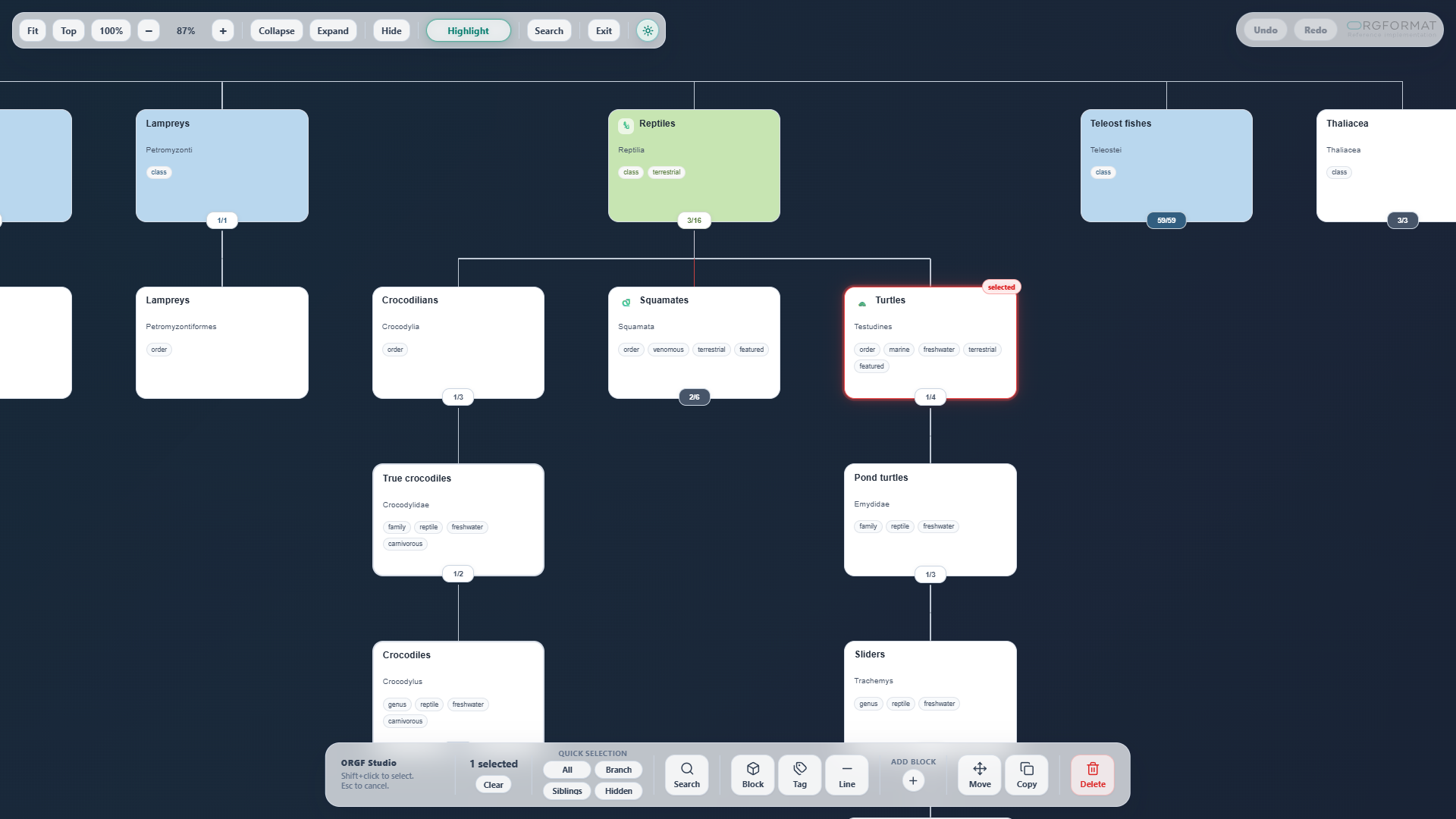
ORGFORMAT Studio used to explore a learning model

LEARNING CASES

Learning cases

BIOLOGY 01

Animal Atlas: Find Your Pet in the Tree of Life

A 1,004-card atlas from the animal kingdom to species and subspecies. Explore the scientific tree through familiar-animal entry routes for cats, dogs, horses, rabbits, rodents, birds, reptiles, and ants; extend missing branches with a teacher or AI, translate Latin names, and shape the model in your own visual language.

GENEALOGY 02

Family Tree

Interview relatives, collect generations and family branches, count family members through value, and share an interactive tree with the people close to you.

LINGUISTICS 03

Language Tree

Build a tree of language families, groups, subgroups, and languages; mark extinct languages and trace links between the languages of writers, cultural figures, and communities.

PALEONTOLOGY 04

Dinosaur or Not?

Explore why pterosaurs and mosasaurs are not dinosaurs, while birds are related to theropod dinosaurs.

HISTORY 05

Dynasty: Branches and Succession

Explore a local historical dynasty through rulers, generations, family branches, and lines of succession. Extend the model with new figures, verified facts, and visual explanations.

COMPATIBILITY

Compatible with learning, research, and game-based approaches

  • Biological taxonomy / systematics — the hierarchy of living nature: kingdom, phylum, class, order, family, genus, and species.
  • Genealogical decomposition — family trees, generations, dynastic branches, origin, and succession.
  • Game design and scenario graphs — game-location architecture, quest decomposition, missions, and nonlinear story trees.
  • Linguistic classification — language families, groups, subgroups, languages, and dialects.
  • Systems theory and systems analysis — decomposing a whole into parts and hierarchical levels of systems engineering.
  • Archival science and bibliography — library collections, knowledge catalogs, and archival document hierarchies.
  • Educational mind mapping — structuring complex textbook material through tree-shaped semantic theses.
  • Text anatomy and literary analysis — acts, chapters, scenes, characters, and plotlines.
  • Introductory data science and data logic — nested objects, attributes, tags, and relationships.
  • Geopolitical atlases and geo-hierarchies — continents, unions, countries, regions, peoples, and nationalities.
  • Chronological trees and history timelines — eras, centuries, periods, wars, and key events.
  • Nomenclature and collection catalogs — minerals, coins, stamps, artifacts, and other objects by category and properties.